 MatsClocks
PowerPoint Presentation Clocks
⏰ Switzerland Time Now
Live Switzerland Time Now Clock in Your PowerPoint Presentation
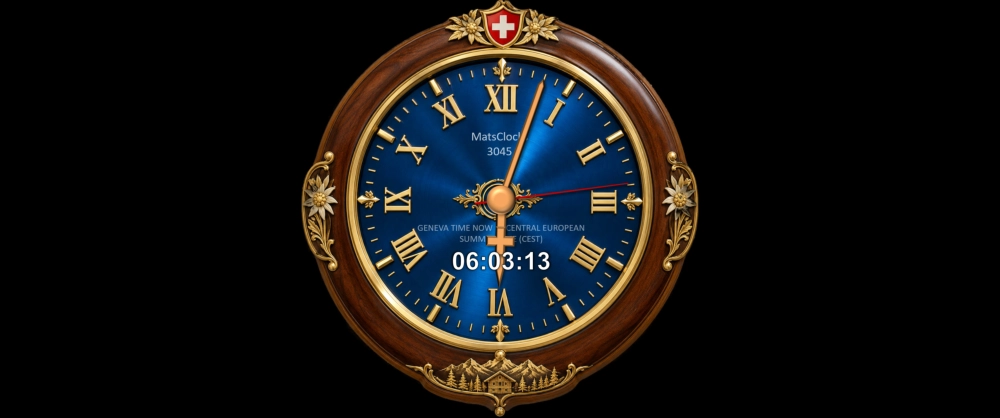
Free Download MatsClocks-3045
Switzerland Time Now Clock
Next Clock >>
MatsClocks 3045 Switzerland Time Now Clock displays live Switzerland Time on your PowerPoint Presentation Slide in both analog clock and the digital timer next to it. You can run this PowerPoint Presentation Clock from anywhere in the world.
All MatsClocks are in Zip files which can be opened using WinZip or any common file compression program. If you do not have PowerPoint software installed in your device, please get Microsoft_Office Software.
Free Download MatsClocks - 3045 and run this PPTM Macro Enabled PowerPoint Presentation slide on your PC or Laptop. It will start showing live Switzerland time now, with hours, minutes and seconds needles as well as a digital time next to it. Just go to presentation mode and the PowerPoint clock will start running Geneva Switzerland time now in full screen.
Switzerland Time Now: A Complete Guide to Switzerland Time, Time Zones, History, and Modern Timekeeping
Knowing the Switzerland Time Now is important for travelers, international businesses, remote workers, students, broadcasters, and anyone communicating with people in Switzerland. Whether you are checking the time in Zürich, Geneva, Bern, Basel, Lausanne, Lucerne, or another Swiss city, the country follows one national time zone.
Switzerland's timekeeping story is also closely connected with its famous railway system, precision engineering, telecommunications, and scientific measurement. What began with different local times eventually evolved into a highly synchronized national system supported today by atomic clocks and sophisticated time-distribution technology.
For anyone who wants a convenient way to keep Swiss time visible during a presentation, the Free Download MatsClocks - 3045 Switzerland Time Now PowerPoint Clock provides an especially useful solution.
Switzerland Time Now at a Glance
Switzerland uses one official time zone throughout the country. During standard time, Switzerland follows Central European Time (CET), UTC+1. During daylight saving time, it changes to Central European Summer Time (CEST), UTC+2.
So the basic pattern is:
- CET: UTC+1
- CEST: UTC+2
- One national time zone
- Daylight saving time: Last Sunday in March to last Sunday in October
In 2026, Switzerland entered summer time on March 29 and is scheduled to return to standard time on October 25.
This seasonal change is an important consideration whenever you want to know the Switzerland Time Now, particularly when comparing Swiss time with another country.
The Fascinating History of Switzerland Time
The history of Switzerland Time is closely intertwined with the development of railways.
Before standardized time, towns and cities could maintain their own local solar time. Noon essentially meant the point when the Sun reached its highest position in the local sky. Because Switzerland stretches geographically from west to east, local solar times naturally differed.
That arrangement became increasingly inconvenient as transportation developed.
Imagine trying to operate a railway system when different towns use slightly different clocks. A timetable that says a train arrives at a particular time becomes much more complicated when every location has its own interpretation of that time.
The arrival of railways made standardized time increasingly important.
According to the Swiss government's historical account, Switzerland began using Bern time for postal, telegraph, and railway traffic from 1853. The country then adopted Central European Time as its national standard in 1894.
That change effectively brought the country onto one national clock.
How Railways Helped Create Modern Switzerland Time
Switzerland's railway history provides an excellent illustration of why standardized time matters.
In the 19th century, railway stations could display different clocks. Historical accounts of Basel station, for example, describe clocks showing Bern time and Paris time for different railway connections.
Today, that seems remarkably complicated.
But at the time, the country was moving from a world of local solar clocks toward a modern transportation network. Standard time helped coordinate railway timetables and made travel between different parts of Switzerland much more predictable.
The relationship between Swiss railways and precise time eventually became part of Switzerland's cultural identity.
The famous Swiss railway clock, designed by SBB engineer Hans Hilfiker in 1944, later became an internationally recognized example of functional Swiss design.
How Many Switzerland Time Zones Exist?
Switzerland has one time zone.
This applies across the country, including major cities such as:
- Zürich
- Geneva
- Bern
- Basel
- Lausanne
- Lucerne
- Lugano
- St. Gallen
You therefore do not need to perform different time-zone calculations when traveling from one Swiss city to another.
Whether you are visiting the Alps, attending a business meeting in Zürich, or exploring Geneva, the official Switzerland time is the same.
Central European and Switzerland Time
The standard Switzerland time is Central European Time, or CET.
CET corresponds to:
UTC +1 hour
For example, when UTC is 12:00, Swiss standard time is 13:00.
Switzerland's legal time is based on Coordinated Universal Time(UTC) , with CET defined as UTC+1.
CET is also used as standard time in many other European countries. This shared system makes cross-border travel, business, broadcasting, and communication easier.
Central European Summer Time
During the summer period, Switzerland moves to Central European Summer Time, abbreviated CEST.
CEST corresponds to:
UTC +2 hours
The clocks move forward by one hour in spring and move back by one hour in autumn.
Switzerland coordinates these changes with other European countries. Under the current rules, the change to summer time occurs on the last Sunday of March and the return to standard time occurs on the last Sunday of October.
This is why the UTC offset associated with Switzerland Time is not identical throughout the year.
Switzerland Time Now and Daylight Saving Time
Switzerland's experience with daylight saving time has changed over the decades.
The country first observed daylight saving time in 1941. There were later periods when it was not observed; 1980 was the last year without daylight saving time before the current system became established.
Switzerland now follows the European seasonal clock-change system.
The purpose of moving the clocks forward is to shift an hour of daylight toward the evening during the summer months.
For someone simply looking for the Switzerland Time Now, however, the practical point is much simpler: remember that Swiss clocks can be either UTC+1 or UTC+2 depending on the season.
The Science Behind Modern Switzerland Time
Switzerland's reputation for precision is not limited to watches and mechanical engineering.
The country also plays an important role in extremely accurate scientific timekeeping.
The Federal Institute of Metrology (METAS) is responsible for realizing and disseminating official Swiss time, known as UTC(CH). METAS operates an ensemble of atomic clocks, including cesium atomic clocks and hydrogen masers, to maintain a highly stable Swiss time scale.
This is a remarkable development from the days when towns simply relied on the position of the Sun.
Modern Swiss time is connected to the international UTC system, allowing computers, communication networks, navigation systems, financial systems, and other technologies to coordinate accurately.
Atomic Clocks and the Future of Switzerland Time
Modern life depends on extremely accurate time.
Consider how many everyday technologies require synchronized clocks:
- GPS navigation
- Mobile phones
- Internet communications
- Computer networks
- Financial transactions
- Telecommunications
- Transportation
- Scientific research
- Data centers
- Industrial systems
METAS notes that precise Swiss time contributes to navigation, telecommunications, internet systems, and other technologies. Its time-distribution services can achieve synchronization ranging from milliseconds to extremely precise sub-nanosecond levels, depending on the technology used.
This is one of the most fascinating advances in the story of Switzerland Time.
A clock once depended on the Sun. Today, Switzerland's official time is maintained using some of the world's most precise scientific instruments.
Switzerland Time and the Internet
The digital age has changed how people interact with time.
Your computer does not need to wait for someone to manually adjust a clock. Modern systems can synchronize automatically with network time services and apply appropriate time-zone rules.
METAS also provides a Network Time Protocol (NTP) service that allows computer clocks to synchronize with official Swiss time.
This synchronization is largely invisible to ordinary users, but it is fundamental to the digital infrastructure people depend on every day.
Why Knowing Switzerland Time Now Matters
Knowing the Switzerland Time Now can be useful in many situations.
International Business
Companies working with Swiss customers, suppliers, financial institutions, or employees need to know the local Swiss time before arranging meetings.
Travel
Travelers need accurate local time for flights, trains, hotels, tours, restaurant bookings, and other activities.
Remote Work
A remote employee may be located thousands of kilometers away from a Swiss client or colleague. A visible Swiss clock can eliminate unnecessary mental calculations.
Education
Teachers can use a Swiss clock when discussing geography, European time zones, international travel, or global communications.
International Events
Conferences, webinars, sports broadcasts, and online events may involve participants across multiple time zones.
In all of these situations, having the correct Switzerland Time immediately available is useful.
MatsClocks 3045 Switzerland Time Now PowerPoint Clock
Free Download MatsClocks - 3045 Switzerland Time Now PowerPoint Clock. It can become a practical addition to a PowerPoint presentation.
Instead of opening a browser, checking a smartphone, or leaving PowerPoint to determine the current Swiss time, a dedicated clock can keep Switzerland's time visible directly on the presentation screen.
That can be particularly useful when PowerPoint is already being used as the primary display.
Imagine an international meeting with participants from Switzerland and other countries. Instead of repeatedly asking what time it is in Switzerland, everyone can simply glance at the presentation screen.
Why Use a Switzerland Time Clock in a PowerPoint Presentation?
PowerPoint Presentation is used in far more situations than traditional corporate presentations.
A Switzerland time now display can be useful in:
- Business meetings
- International conferences
- Classrooms
- University lectures
- Training sessions
- Webinars
- Travel presentations
- International project management
- Customer-support environments
- Digital information displays
The benefit is simple: the Switzerland time stays where your audience is already looking.
There is no need to switch applications or interrupt a presentation simply to check the clock.
Switzerland Time for International Meetings
Imagine a team based in India working with colleagues in Zürich.
Without a dedicated Switzerland time now clock, someone may need to calculate the time difference before every meeting.
With a visible Swiss time display, the answer is immediate.
The same principle applies to teams working between Switzerland and:
- North America
- Asia
- Australia
- Africa
- The Middle East
- Other European countries
The seasonal change between CET and CEST makes an automatically updated time reference even more useful.
Switzerland Time for Travelers
Switzerland attracts visitors throughout the year for business, tourism, skiing, hiking, culture, shopping, and international events.
A traveler might visit Zürich in the morning, travel by train to Lucerne, continue toward the Alps, and eventually visit Geneva.
Despite the geographical journey, the traveler remains within the same national time zone.
That simplicity is convenient.
The challenge comes mainly when comparing Swiss time with the time at home.
A dedicated Switzerland Time Now clock can provide an easy reference when planning international travel.
Switzerland Time and Swiss Precision
There is something particularly fitting about having a Swiss time clock in a PowerPoint presentation.
Switzerland is internationally associated with precision, engineering, watches, railways, and careful timekeeping.
The historical development of Swiss time demonstrates that reputation.
The country moved from different local times to Bern time, then to a national Central European standard, and eventually to an official time scale maintained with atomic clocks and connected to global UTC.
The technology has changed enormously, but the objective has remained the same:
Make sure everyone knows what Switzerland time now is.
CET vs. CEST in Switzerland
Here is the simplest way to remember the two Swiss time standards:
| Time Standard | UTC Offset | Period |
|---|---|---|
| Central European Time (CET) | UTC+1 | Standard time |
| Central European Summer Time (CEST) | UTC+2 | Daylight saving time |
During 2026, Switzerland's daylight saving period runs from March 29 through October 25.
The Evolution of Switzerland Time
The evolution of Switzerland time can be viewed as a journey through several important stages:
Local Solar Time
Different towns naturally kept slightly different times based on the
Sun.
Railway Time
The growth of railways created an urgent need for coordinated schedules.
Bern Time
From 1853, Switzerland used Bern time for postal, telegraph, and railway
traffic.
National CET
Switzerland adopted Central European Time as its national standard in
1894.
Daylight Saving Time
Seasonal clock changes were introduced and later became part of the
modern European system.
Atomic Time
Modern
Switzerland time now is realized through highly precise atomic clocks and
synchronized with UTC.
Digital Synchronization
Network technologies now allow computers and other systems to
synchronize with official time.
It is an extraordinary transformation.
Why a Visible Switzerland Time Now Clock Still Matters
With smartphones, computers, and smart watches everywhere, it might seem unnecessary to have another clock.
But visibility has its own value.
A clock displayed prominently on a large screen does not require anyone to search for it. It is simply there.
For a meeting room, classroom, conference, or presentation, that can be surprisingly useful.
The MatsClocks 3045 Switzerland Time Now PowerPoint Clock is designed around precisely this idea: make Switzerland Time readily visible within a PowerPoint environment.
Final Thoughts on Switzerland Time Now
The story of Switzerland Time Now is much more than a question of whether the clock says 10:00 or 11:00.
It is a story of transportation, technology, science, precision, and national coordination.
Switzerland time has moved from a period when individual communities followed local solar time to a nationally standardized clock. The railways played a major role in that transformation, with Switzerland adopting Central European Time as its national standard in 1894.
Today, Switzerland time uses one national time zone, switching between CET (UTC+1) and CEST (UTC+2) according to the European daylight-saving schedule.
Behind the familiar clock on the wall is an impressive scientific infrastructure. Swiss atomic clocks and time-distribution systems help synchronize everything from computers and telecommunications to navigation and other modern technologies.
For anyone who regularly needs to know the Switzerland Time Now, Free Download MatsClocks - 3045 Switzerland Time Now PowerPoint Clock offers a convenient way to keep Switzerland time now visible during PowerPoint presentations, meetings, lessons, events, and international collaboration.
From railway timetables to atomic clocks, Switzerland time reflects one enduring principle:
When precision matters, knowing the right time matters.
Free Download MatsClocks-3045
Switzerland Time Now Clock
Next Clock >>
Note:
If you do not have PowerPoint software installed in your device then
please get
Microsoft_Office Software with essential Office
software apps like Word, PowerPoint, Excel, and One Note etc. If you
already have Microsoft Office installed then please update it today to get
all the latest features.