 MatsClocks
PowerPoint Presentation Clocks
⏰ Iceland Time Now
Live Iceland Time Now Clock PowerPoint Presentation Slide
Download
Iceland Time Now Clock
Next Clock >>
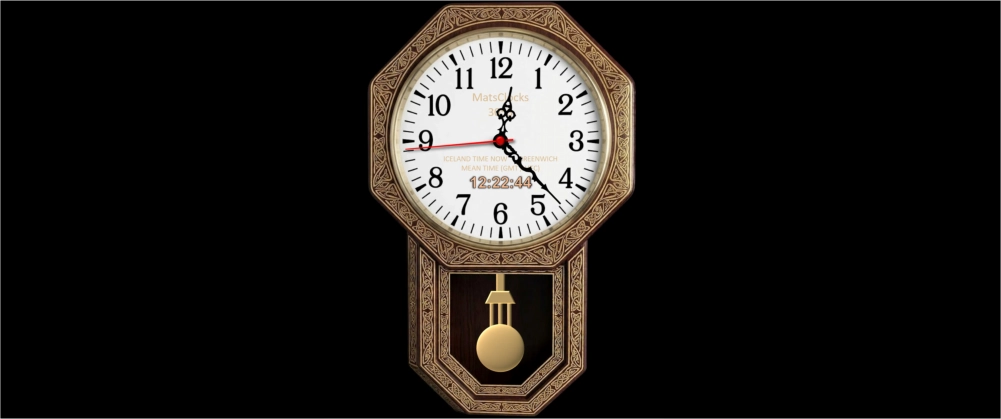
MatsClocks 3054 Iceland Time Now Clock displays Live Iceland Time Now on your PowerPoint Presentation Slide in both analog clock and a digital clock next to it, irrespective of which country in the world you run this PowerPoint Slide. MatsClocks 3054 caters for Daylight Saving Time automatically and this PowerPoint clock starts running the moment you go to presentation mode. Every Whole Hour, this clock chimes a beautiful bell sound. All MatsClocks are in Zip files which can be opened using WinZip or any common file compression program. Get the latest Microsoft_Office Software to run PowerPoint on your devices.
Iceland Time Now: Culture, Cities, Sights and Iceland Tour Packages
Planning an Iceland trip? Get the local Iceland time now with MatsClocks 3054, discover the country’s character, and find memorable places to explore from Reykjavík to the northern fjords. There are various Iceland Tour Packages available from which you can choose and save money without compromising on the travel experience.
Iceland Time Now
Iceland stays on UTC+0 (Greenwich Mean Time) all year, so the clock does not jump forward or back in spring and autumn. A live clock can change every minute, but the time-zone rule is refreshingly simple: wherever you are in Iceland, you use the same time. The history behind that choice appears at the end of this guide.
Time is a useful starting point for a trip here. Iceland’s long summer evenings can make a day feel wonderfully spacious, while midwinter daylight is brief and precious. Your watch may stay steady, but your plans should follow the light, weather and road conditions.
Iceland is a Country of intimate Towns and Huge Landscapes
Iceland has one capital city and many smaller towns and villages, each with its own pace and relationship to the land. Reykjavík is the natural first stop for museums, restaurants and live music. Akureyri and Húsavík make northern exploration feel accessible. Selfoss and Vík open onto the south’s waterfalls, beaches and glaciers. Ísafjörður and Egilsstaðir lead into fjords and quieter countryside. These hubs are starting points, not city limits: many of the most famous natural sights sit outside town and are best reached as part of a planned day trip or longer route.
Reykjavík: Culture by the Sea
Reykjavík is compact enough to explore on foot, yet it offers a full introduction to Icelandic life. Begin at Hallgrímskirkja, the landmark church whose stepped tower echoes the island’s basalt scenery. From the tower, colorful roofs, the harbor and distant mountains open into one wide panorama. Nearby, Skólavörðustígur, often called Rainbow Street, leads into a lively center of galleries, wool shops, cafés and restaurants.
Walk downhill toward Harpa, the concert hall beside the water. Its glass façade catches Iceland’s changing light, and the building’s foyer is worth seeing even if you have no performance booked. A short waterfront stroll brings you to Sun Voyager (Sólfar), Jón Gunnar Árnason’s sculptural “dream boat,” set against Faxaflói Bay and Mount Esja. If you are planning a vacation in Iceland then great deals on Iceland Tour Packages are available at great discounts.
For context on the people and landscapes behind the scenery, visit The Settlement Exhibition, built around archaeological remains from Reykjavík’s earliest settlement, or the National Museum of Iceland for a wider journey through the country’s past. Perlan, on Öskjuhlíð hill, combines city views with exhibitions about Iceland’s glaciers and natural forces. Down by the Old Harbour and Grandi, former industrial buildings now sit alongside museums, cafés and whale-watching departures. Reykjavík’s official visitor guide highlights these museums, landmarks and neighborhoods as central parts of the city experience.
Akureyri: Gardens, Art and a Northern Welcome
Set beside the long Eyjafjörður fjord, Akureyri is
Iceland’s second-largest urban center and a practical base for northern
adventures. Its steep streets lead toward Akureyrarkirkja,
the town’s best-known landmark, while the harborfront’s Hof
Cultural and Conference Centre hosts performances and events.
Slow down in Akureyri Botanical Garden, where native
Icelandic plants grow alongside species from around the world in a
sheltered setting. In the older neighborhoods, historic houses, small
museums and Listagilið (Art Street) reward an unhurried
wander. The town’s public swimming pool is another good place to
experience everyday local culture: warm outdoor pools and hot tubs
remain inviting even when the air is chilly. Across the fjord,
Forest Lagoon pairs geothermal bathing with views back toward
town.
Akureyri also makes an appealing launch point for the
Diamond Circle. The route’s nearby highlights include
the broad horseshoe-shaped Goðafoss, the volcanic
formations around Lake Mývatn, and, farther away,
Dettifoss and Ásbyrgi Canyon. The
regional visitor guide describes the north as much more than a single
loop, with fishing towns, islands, geothermal landscapes and long
coastal roads to explore.
Húsavík: Whales, Sea Stories and a Warm-Water View
On the eastern shore of Skjálfandi Bay, Húsavík has
a working harbor and a strong connection to the sea. Whale-watching
trips are a major draw, though wildlife sightings are never guaranteed;
the town’s Whale Museum is a rewarding land-based visit, with exhibits
and whale skeletons that make the scale of these animals vivid. The
Whale Museum has been devoted to whales and their habitat since 1997.
Advertisement
✈️ BIG TRAVEL DREAMS. INCREDIBLE DEALS. BOOK NOW! 🌍
🔥 Don’t wait—your next adventure is calling! Visit Trip.com now, grab the best deals, and BOOK YOUR TRIP TODAY!
Your next unforgettable adventure starts at Trip.com! Grab amazing discounts on flights, hotels, train tickets, car rentals, and must-see attractions worldwide. Whether it’s a dream vacation to Iceland or a spontaneous getaway to any tourist places in the world, Save more with our generous Discounts, and experience more, with every booking.
The timber Húsavík Church, built in the early twentieth century, is an elegant stop near the center. For a distinctly Icelandic way to end the day, head to GeoSea, where geothermal heat warms mineral-rich seawater in cliffside baths overlooking the bay. Húsavík is also a gateway to the Diamond Circle’s nearby wonders, including Lake Mývatn, Goðafoss and Ásbyrgi; leave enough time between stops to enjoy the scenery rather than racing through it.
Selfoss: a Food Stop with History Close at Hand
Selfoss is South Iceland’s largest town and a
convenient base for the Golden Circle and the south coast. The modern
Selfoss Center brings together reconstructed historic
façades, shops and places to eat, while The Old Dairy (Mjólkurbúið)
has become a food hall and cultural stop. Inside, Skyrland
introduces visitors to skyr, the tangy dairy food closely associated
with Icelandic cuisine, through an exhibition that links food, farming
and national history.
A short drive reaches Urriðafoss, a powerful, wide
waterfall on the Þjórsá River. The coastal villages Eyrarbakki
and Stokkseyri offer a different mood: historic houses,
sea air, local museums and long horizons. From Selfoss, the classic
Golden Circle sights, Þingvellir National Park,
Geysir geothermal area and Gullfoss, are all
within reach, making it easy to combine comfortable town evenings with
days outdoors.
Vík: black sand, sea cliffs and south-coast drama
ík í Mýrdal, often shortened to Vík, is a village
rather than a city, but it is one of the most useful southern bases. Its
church sits on a hill above the clustered rooftops, an especially
striking viewpoint when clouds move across the coast. In town, the
Katla Centre and the Icelandic Lava Show
offer indoor ways to understand the volcanic forces that shaped this
region.
Just outside Vík, Reynisfjara is famous for black sand,
basalt columns and the offshore Reynisdrangar sea stacks. It is
beautiful and dangerous: powerful waves can surge unexpectedly, so
visitors should obey warning lights, stay well back from the water and
never turn their backs on the surf. The cliffs and arch at
Dyrhólaey provide broad coastal views and seasonal birdlife.
West along the coast, Skógafoss drops in a tall,
dramatic curtain beside the Skógar museum; Seljalandsfoss
is known for the path that can take visitors behind its cascade when
conditions allow. These are signature stops along the South Coast.
Ísafjörður: A Small Town with a Deep Maritime Story
Surrounded by steep mountains in the Westfjords, Ísafjörður
is the region’s main service town and a rewarding destination in its own
right. Walk the old streets to see nineteenth-century timber houses,
browse the harbor and visit the Westfjords Heritage Museum,
where fishing boats, tools and everyday objects tell how closely local
life has been tied to the sea.
For a close-up of traditional fishing life, the Ósvör Maritime
Museum in nearby Bolungarvík recreates a nineteenth-century
fishing station. Farther afield, Dynjandi, a tiered
waterfall tumbling down a mountainside, is among the Westfjords’ most
memorable drives. Boat trips and guided excursions can also reach remote
areas such as Hornstrandir Nature Reserve. Roads are
long, services are fewer than in the south, and seasonal conditions
matter; allow extra days rather than squeezing this region into a rushed
detour.
Egilsstaðir and Seyðisfjörður: Forest, Folklore and Fjord Life
In the east, Egilsstaðir is a practical hub near
Lake Lagarfljót, whose folklore includes a legendary
lake creature, and Hallormsstaðaskógur, Iceland’s
largest national forest. The hike to Hengifoss rewards
patient walkers with a high waterfall framed by striking layers of red
clay and dark basalt. Nearby, Vök Baths offers a soak
in floating pools on Lake Urriðavatn.
From Egilsstaðir, the mountain road to Seyðisfjörður
descends into a fjord town known for its colorful historic wooden
buildings and creative community. The painted Rainbow Street
leads to the pale-blue church, while Tvísöngur, a
concrete sound sculpture on the hillside, invites visitors to experience
music and landscape together. The Eastfjords are at their best when you
give the winding roads and small communities time to unfold.
Culture You Can Taste, Hear and Join
Icelandic culture is shaped by language, literature, the sea and a
close relationship with the natural world. Icelandic remains the
national language; English is widely spoken, but learning a greeting
such as góðan daginn (“good day”) is a friendly way to
begin. Sagas and folklore remain part of the cultural imagination, while
contemporary music, design, visual art and independent publishing are
easy to encounter in Reykjavík and regional towns.
Food is a natural part of the journey. Look for fresh fish, lamb, rye
bread, skyr and produce grown in geothermal greenhouses. In many towns,
the public swimming pool is more than a place to exercise: it is a warm
social space where neighbors meet in the hot tubs and catch up.
Iceland’s geothermal bathing tradition remains part of ordinary life,
not only a spa experience.
Travel respectfully by staying on marked paths, taking litter with you
and following local safety notices. Moss, nesting birds, changing
weather and powerful coastal conditions all deserve care. A slower
itinerary usually leads to better conversations, more time in local
cafés and fewer hurried photo stops.
Find Iceland Tour Packages on Trip.com
A well-chosen package can make a first Iceland trip easier to
organize, especially when it combines accommodation, airport transfers
and guided day trips.
Trip.com lists Reykjavík-based
options such as Golden Circle tours, South Coast excursions and
multi-day packages. One listed four-day Reykjavík-based package
combines accommodation, breakfast, airport transfers and selected day
tours, while the wider listings let travelers compare activities and
dates.
Inclusions and availability can vary, so check the details for your
dates before booking.
If you have only a few days, choose a Reykjavík stay with one or two
guided excursions. With more time, look for a route that includes the
south coast or a multi-day circuit. A package is especially helpful in
winter, when shorter daylight and changing road conditions can make
guided transport reassuring. However you travel, leave room for a
geothermal swim, a town stroll and an unplanned stop when the landscape
catches your attention.
Tourism is a significant part of Iceland’s economy, supporting
accommodation, transport, restaurants, guides and regional services.
Preliminary Statistics Iceland figures estimate that tourism accounted
for 8.8% of GDP in 2025, while visitor consumption
reached nearly ISK 914 billion (Iceland
Tourism Statistics)).
Choosing local food, guides and guesthouses helps that travel spending
reach communities across the country.
Iceland Time Zones and The History of The Clock
The quick answer to Iceland Time Now is
UTC+0. Iceland uses one
time zone nationwide, including Reykjavík, Akureyri, the Westfjords and
the Eastfjords. It does not currently observe daylight saving time,
so clocks remain on the same offset throughout the year. That makes
calendar planning simple: Iceland’s local time does not shift
seasonally, even when nearby countries move their clocks.
This steady system has a history. Iceland once used seasonal clock
changes, but in 1968 the Alþingi (Iceland’s parliament) passed a law
stating that time throughout the country would be counted by Greenwich
Mean Time year-round. The parliamentary record describes the change as
ending the twice-yearly clock adjustment. The practical effect is that
Iceland kept the clock setting that had previously served as “summer
time” and used it as the standard in every season.
So when you check the time in Iceland, remember two things: the clock is
consistent, but the daylight is not. In summer, long evenings invite
late walks and extended road trips; in winter, the shorter day
encourages early starts and flexible plans. Set your watch to Iceland
time, then let the season shape the rest of your itinerary.
Free Download MatsClocks-3054
Iceland Time Now Clock
Next Clock >>
Get
Microsoft_Office Software to run PowerPoint. And get
WinZip to unzip the .zip file and extract the
MatsClocks PowerPoint Clocks.