 MatsClocks
PowerPoint Presentation Clocks
⏰ Brazil Current Time Now
Live Brazil Current Time Now Clock in Your PowerPoint Presentation
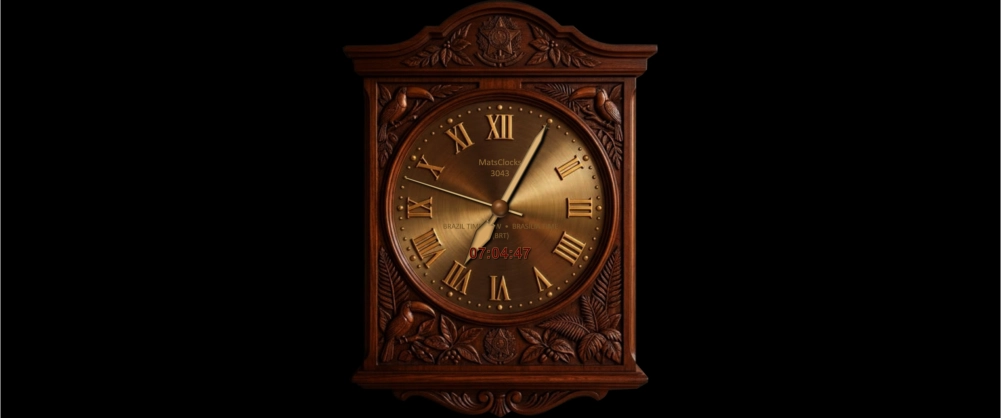
Free Download MatsClocks-3043
Brazil Current Time Now Clock
Next Clock >>
MatsClocks 3043 Brazil Current Time Now Clock displays live Brasília Time (BRT) UTC-3:00 on your PowerPoint Presentation Slide in both analog clock and the digital timer next to it. Brasília Time (BRT) is used by almost 93% of the people living in Brazil.
All MatsClocks are in Zip files which can be opened using WinZip or any common file compression program. If you do not have PowerPoint software installed in your device, please get Microsoft_Office Software.
This MatsClocks 3043 displays the Brazil Current Time Now (UTC-3:00), in all major cities in Brazil as listed below:
- São Paulo (São Paulo)
- Rio de Janeiro (Rio de Janeiro)
- Brasília (Federal District - Capital)
- Salvador (Bahia)
- Fortaleza (Ceará)
- Belo Horizonte (Minas Gerais)
- Curitiba (Paraná)
- Recife (Pernambuco)
- Porto Alegre (Rio Grande do Sul)
- Belém (Pará)
- Goiânia (Goiás)
- São Luís (Maranhão)
- Maceió (Alagoas)
- Natal (Rio Grande do Norte)
- Teresina (Piauí)
- João Pessoa (Paraíba)
- Aracaju (Sergipe)
- Vitória (Espírito Santo)
- Florianópolis (Santa Catarina)
- Macapá (Amapá)
- Palmas (Tocantins)
Free Download MatsClocks - 3043 and run this PPTM Macro Enabled PowerPoint slide on your PC or Laptop. It will start showing live Brazil current time now, with hours, minutes and seconds needles as well as a digital time next to it. Just go to presentation mode and the PowerPoint clock will start running Brazil current time now in full screen.
Free Download MatsClocks-3043
Brazil Current Time Now Clock
Next Clock >>
Note:
If you do not have PowerPoint software installed in your device then
please get
Microsoft_Office Software with essential Office
software apps like Word, PowerPoint, Excel, and One Note etc. If you
already have Microsoft Office installed then please update it today to get
all the latest features.
Brazil Current Time Now: Understanding Brazil Time Now
Knowing the Brazil Current Time Now is more important than it may first appear. Brazil is enormous, stretching across much of South America, and its territory covers several different time zones. That means there is not always one single answer to the question, “What time is it in Brazil?”
For travelers, international businesses, students, investors, broadcasters, sports fans, and anyone communicating with people in Brazil, understanding Brazil Time Now can prevent missed meetings, confusing phone calls, and scheduling mistakes.
Brazil's approach to time has also changed considerably over the years. From the creation of an official national time system to the adoption and later suspension of daylight saving time, the story of Brazilian time reflects the country's geography, economic development, technology, and changing energy needs.
Brazil Current Time Now at a Glance
Brazil currently observes four standard time zones across its territory:
- UTC−2: Fernando de Noronha Time (0.0016% of Brazil's population use this timezone)
- UTC−3: Brasília Time (used by 93% people in Brazil)
- UTC−4: Amazon Time (6% of Brazil's population)
- UTC−5: Acre Time (0.5% of Brazil's population)
Brasília Time, at UTC−3, is the country's best-known time zone because it covers Brasília and many of Brazil's largest cities, including São Paulo and Rio de Janeiro.
The important point is that Brazil Current Time Now depends on where in Brazil you are. A person in Rio de Janeiro can have a different local time from someone in the western Amazon or Acre.
Brazil's National Observatory provides information about the country's official time and time zones and recommends checking the appropriate national source for detailed regional time information.
The Early Development of Time in Brazil
Before modern standardized timekeeping, people naturally relied heavily on the position of the Sun. Local solar time could vary from one place to another because sunrise, noon, and sunset occur at different moments depending on longitude.
As Brazil's cities expanded and transportation, commerce, shipping, and communication became more important, this local approach became increasingly inconvenient.
The need for a standardized civil time was already becoming apparent in the period following Brazilian independence in 1822. Increased movement of ships through the Port of Rio de Janeiro was one of the factors contributing to the need for a more formal system of timekeeping.
A major milestone came in 1913, when Brazil formally regulated its legal time. The legislation divided Brazilian territory into four time zones and established the Greenwich meridian as the fundamental reference for legal time.
This was an important step toward the modern concept of Brazil Time Now.
The Role of the National Observatory
One fascinating part of Brazil's timekeeping history is the role played by the Observatório Nacional, or National Observatory.
The institution has been responsible for generating, maintaining, and disseminating Brazil's legal time. The National Observatory's time services have evolved from traditional astronomical observations into highly precise modern time and frequency measurement systems.
Today, the institution remains responsible for the Hora Legal Brasileira, or Brazilian Legal Time. Its work supports applications that depend on accurate synchronization, including telecommunications, technology, scientific research, financial systems, and other activities where precise time matters.
Free Download MatsClocks 3043 Brazil Time Now Clock.
So when we talk about accurate Brazil Current Time Now, there is a sophisticated scientific and technological system behind that seemingly simple clock display.
Why Does Brazil Have Several Time Zones?
Brazil is one of the world's geographically largest countries. It extends a considerable distance from east to west, meaning different parts of the country experience solar noon at substantially different moments.
If the entire country used exactly the same local time, sunrise and sunset would occur at very different clock times across its territory.
Multiple time zones make everyday life more practical.
For example, the eastern parts of Brazil are closer to the reference meridian used for Brasília Time, while western regions are several hours behind it. The result is a system that allows clocks to better correspond with the position of the Sun in different parts of the country.
This is one of the most important peculiarities of Brazil Time Now: the phrase does not necessarily describe one universal clock reading.
The Four Brazilian Time Zones
1. Brasília Time (UTC−3)
Brasília Time is the time zone most people associate with Brazilian national time, over 93% of Brazil's population use it.
It covers Brasília and many of the country's major population centers, including São Paulo and Rio de Janeiro.
Because so much of Brazil's government, business, finance, media, and international communication operates around this zone, UTC−3 is often the most useful reference when someone casually asks for the Brazil Current Time Now.
2. Amazon Time (UTC−4)
Several areas of western Brazil use Amazon Time, which is one hour behind Brasília Time.
This time zone is particularly important when dealing with locations in parts of the Amazon region and other western areas.
The difference can become significant for people arranging meetings between eastern and western Brazil.
3. Acre Time (UTC−5)
Acre Time is used in Acre and represents Brazil's westernmost standard time zone.
It is two hours behind Brasília Time.
This illustrates why simply searching for “Brazil time” without specifying a location can sometimes create confusion.
4. Fernando de Noronha Time (UTC−2)
Brazil also has an island time zone that is one hour ahead of Brasília Time.
Fernando de Noronha and certain other Atlantic islands use UTC−2.
Although this population is much smaller than that of Brazil's mainland cities, it is an important part of Brazil's official time-zone structure.
Is Daylight Saving Time Used in Brazil?
This is one of the most common questions people have about Brazil Current Time Now.
Brazil does not currently observe daylight saving time.
Brazil has, however, used daylight saving time at various points throughout its history.
The first Brazilian daylight-saving period began in 1931, during the administration of President Getúlio Vargas. The initial period ran from October 3, 1931, until March 31, 1932.
Daylight saving time was subsequently introduced, discontinued, and reintroduced during different periods.
The policy was particularly associated with attempts to make better use of daylight and reduce electricity consumption.
Why Did Brazil Use Daylight Saving Time?
The basic idea behind daylight saving time is simple.
During certain seasons, the Sun can rise relatively early. By moving clocks forward by one hour, people can potentially shift more daily activity into daylight hours.
Historically, Brazil used daylight saving time primarily in connection with electricity consumption and demand management.
However, Brazil's energy-use patterns changed over time. According to Brazil's Ministry of Mines and Energy, studies conducted in 2019 found that daylight saving time was no longer producing the expected electricity-saving and demand-reduction benefits. Changes in consumer habits had shifted electricity demand in ways that reduced the policy's previous advantages.
As a result, Brazil's daylight-saving system was ended by Decree No. 9,772 of April 25, 2019.
Brazil Time Now and Daylight Saving Confusion
People searching for Brazil Time Now sometimes find older websites or applications that still mention Brazilian daylight saving time.
This can create unnecessary confusion.
Historical references to Brazilian daylight saving time are accurate for the periods when the policy was active, but they should not automatically be applied to today's Brazilian clocks.
For modern scheduling, it is important to use the current time-zone rules for the specific Brazilian location rather than assuming that clocks move forward or backward seasonally.
What Makes Brazil Current Time Now Peculiar?
There are several interesting characteristics of Brazilian time.
Brazil Has Multiple Time Zones
The biggest peculiarity is geographical. Brazil is not a single-time-zone country.
Its four current standard time zones span from UTC−2 to UTC−5.
Brasília Time Is Widely Used as the Main Reference
Although Brazil has four time zones, Brasília Time is the most commonly encountered in national-level discussions.
That is why many international websites and people use Brasília as their reference when they talk about Brazilian time.
Brazil Does Not Currently Change Its Clocks for Daylight Saving Time
Unlike countries that move clocks forward and backward during the year, Brazil's current standard-time system does not include a regular daylight-saving change.
The Country's Size Makes Time Differences Important
The geographical scale of Brazil means that a business meeting scheduled for 10:00 in Brasília Time may not be 10:00 everywhere else in Brazil.
This is particularly important for companies with offices, customers, employees, or suppliers spread across different Brazilian regions.
Brazil Current Time Now for International Business
Brazil plays a major role in the South American economy, making its time zones important for international business.
A company in Europe, North America, or Asia arranging a video conference with Brazilian colleagues needs to know the exact Brazilian location involved.
Imagine scheduling a meeting with a company in São Paulo. Brasília Time would be the appropriate local reference. But if another participant is located in Acre, the local clock there will show a different time.
For this reason, professional scheduling software normally identifies the city or time-zone name rather than relying only on the word “Brazil.”
Brazil Time Now for Travelers
Travelers also benefit from understanding Brazilian time zones before arriving.
Brazil is so large that traveling across the country can involve a change in local time even though the traveler has remained within the same nation.
This can affect:
- Flight schedules
- Hotel check-in times
- Tour reservations
- Train and bus connections
- Business appointments
- Restaurant bookings
- Telephone calls
- Online meetings
- Airport transfers
Free Download MatsClocks 3043 Brazil Time Now Clock.
Checking Brazil Current Time Now for the destination city is therefore a simple but valuable travel habit.
Brazil Time Now for International Calls and Meetings
If you live outside Brazil and need to contact someone there, avoid saying simply, “Let's talk at 3 PM Brazil time.”
Instead, identify the city whenever possible.
For example:
3:00 PM in São Paulo is a much clearer reference than simply saying 3:00 PM in Brazil.
This small distinction can eliminate a surprising amount of confusion.
It is especially useful for multinational companies whose employees may work with people in different Brazilian states.
Brazil Current Time Now and Technology
Modern technology has made following Brazilian time considerably easier.
Computers, smartphones, calendars, video-conferencing platforms, and scheduling systems can automatically adjust time according to the selected location and time zone.
However, technology is only as reliable as the location information supplied to it.
If someone selects the wrong Brazilian city or time zone, an automatically generated meeting time can still be wrong.
That is why understanding the fundamentals of Brazil Time Now remains useful even in an age of automatic time-zone conversion.
The Importance of Accurate Timekeeping
Accurate time is much more than knowing whether the clock says 10:00 or 10:05.
Modern society depends on synchronized time.
Banking transactions, telecommunications, internet services, transportation, scientific experiments, computer networks, navigation systems, broadcasting, and business operations all rely on accurate clocks.
Brazil's National Observatory continues to operate specialized services for generating, maintaining, and disseminating Brazilian legal time.
The science behind accurate timekeeping has also become increasingly sophisticated. Modern time standards rely on highly precise frequency measurements rather than simply observing the Sun.
Brazil Time Now in Everyday Life
For ordinary daily life, the most important lesson is simple: always consider the location.
If someone asks, “What is the Brazil Current Time Now?” the useful follow-up is often:
“Which city or region in Brazil?”
São Paulo, Rio de Janeiro, Brasília, Manaus, Rio Branco, and Fernando de Noronha do not necessarily share the same clock time.
Once the location is known, determining the correct local time becomes much easier.
A Brief Timeline of Brazilian Time
Brazil's timekeeping story can be summarized through several important milestones:
1822: Following independence, the growth of transportation and commerce increased the need for standardized civil time.
1913: Brazil formally regulated its legal time, establishing a system of four time zones and assigning responsibility for the generation and dissemination of legal time.
1931: Brazil introduced daylight saving time for the first time.
1949–1953: Daylight saving time returned for another period.
1963–1968: Brazil again used daylight saving time.
1985 onward: Daylight saving time became a recurring policy during various periods, with its geographic coverage changing over the years.
2019: Brazil formally ended the daylight-saving system through Decree No. 9,772.
Today: Brazil operates four standard time zones and does not currently use daylight saving time.
Why You Should Check Brazil Current Time Now
Knowing the correct Brazil Current Time Now can be valuable for almost anyone who interacts with Brazil.
Free Download MatsClocks 3043 Brazil Time Now Clock.
It helps international businesses schedule meetings correctly. It helps travelers plan their journeys. It helps families stay in touch across continents. It helps students attend online classes without confusion. It helps broadcasters, journalists, sports fans, investors, and remote workers coordinate activities accurately.
Most importantly, understanding Brazil's time zones prevents the assumption that the entire country operates on one identical clock.
Final Thoughts on Brazil Current Time Now
The story of Brazil Current Time Now is really a story about how a huge country learned to organize time across an enormous geographical area.
From the early need to standardize local time to the formal establishment of Brazilian Legal Time in 1913, and from decades of experimentation with daylight saving time to today's four-zone system, Brazilian timekeeping has continually adapted to the country's changing needs.
Today, the key fact to remember is simple: Brazil has four standard time zones, ranging from UTC−2 to UTC−5, and daylight saving time is not currently observed.
So, the next time you need to know Brazil Time Now, don't look only for the country name. Look for the city or region as well. That small extra detail can make the difference between an approximate answer and the correct local time.
Whether you are planning a business meeting, arranging a trip, calling a friend, following an event, or simply satisfying your curiosity, understanding Brazilian time makes it much easier to stay connected with one of the world's largest and most fascinating countries.
MatsClocks 3043 shows you the Brazil Current Time Now in a PowerPoint Presentation. It runs independent of your computer clock and show you the Brazil time now (UTC-3:00) irrepective of where you run this presentation clock.
Free Download MatsClocks-3043
Brazil Current Time Now Clock
Next Clock >>